
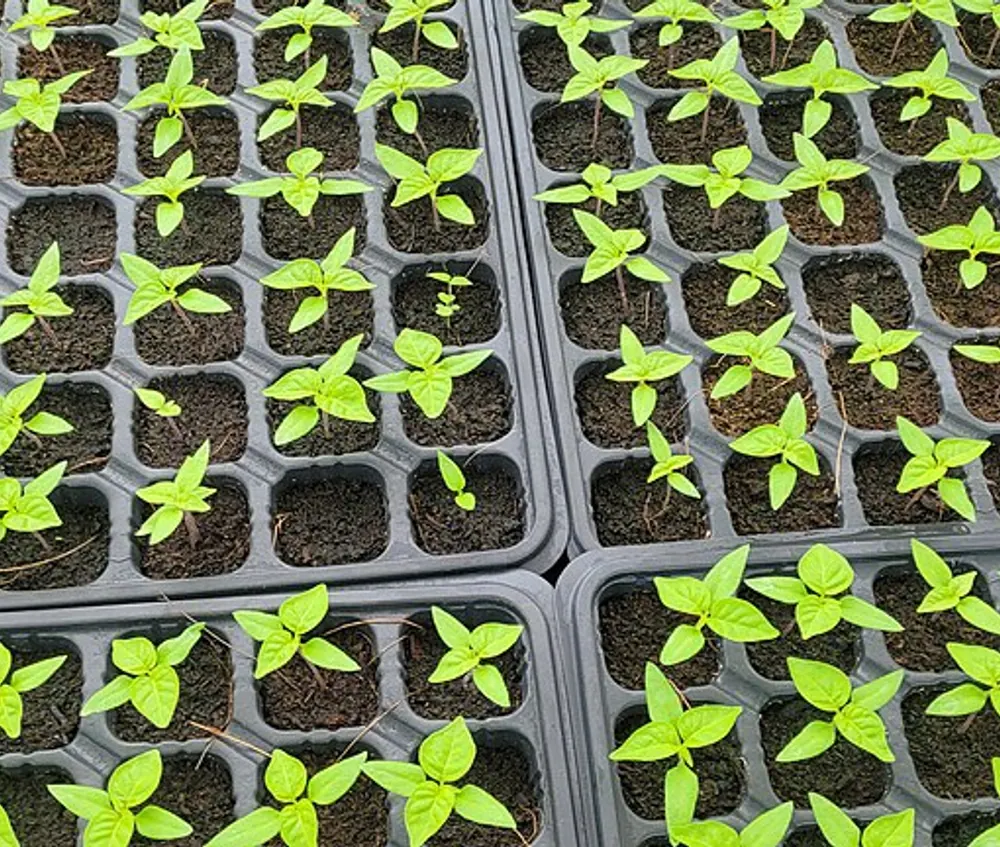
A 128-cell tray increases plants per bench, while a 72-cell tray generally gives each plug more rooting volume. That is the useful starting point, not a universal verdict. The correct choice depends on transplant age, variety, climate, irrigation control, growing medium, transport distance and whether the nursery sells compact young plugs or larger established seedlings.
Decision in one minute
| Nursery condition | Likely starting point | Reason to verify |
|---|---|---|
| Short nursery cycle and precise irrigation | 128 cell | Higher density; smaller plugs dry faster |
| Longer holding period | 72 cell | More root volume and buffering |
| Hot, dry nursery | 72 cell | Larger plugs may reduce rapid moisture swings |
| Limited bench area | 128 cell | More plants per tray and per square metre |
| Long transport or delayed planting | 72 cell | Larger plug may tolerate handling better |
Why cell count alone is incomplete
Two trays with the same count can have different top openings, depths, tapers and cell volumes. Compare measured cell volume and tray dimensions, not only the number printed in a catalogue.
Tomato and pepper varieties also differ in vigor. Grafted seedlings, older transplants and plants held for uncertain delivery dates normally need more reserve than young seedlings moved on a fixed schedule.
The real trade-off: density versus control
A 128-cell format can lower bench space, medium and transport volume per plant. The trade-off is a smaller moisture and nutrient buffer. Irrigation uniformity, nozzle selection, airflow and daily monitoring become more important.
A 72-cell format uses more space and medium per seedling but can support a longer nursery period and a larger transplant. That benefit disappears if cells remain saturated or roots spiral because the crop is held too long.
Run a nursery trial before a bulk order
- Fill both tray options with the same measured medium
- Sow the same variety on the same date
- Record germination, irrigation frequency and uneven drying
- Measure plug cohesion, root distribution and stem quality
- Test extraction with the actual transplant method
- Simulate packing, transport and one day of planting delay
- Compare usable transplants per tray, not only seeds sown
Seedling tray quotation checklist
Send crop and variety, nursery days, target transplant size, cell count, measured cell volume, outside dimensions, tray material and weight, drainage-hole design, reuse expectation and packing quantity.
Ask for a sample that fits existing benches, filling equipment and transport crates. A low tray price is not a saving if inconsistent forming, weak corners or poor nesting increases nursery labor and plant loss.
Frequently asked questions
Is a 72-cell or 128-cell tray better for tomato seedlings?
Neither is universally better. A 128-cell tray favors density and short controlled cycles; a 72-cell tray usually provides more root volume for longer cycles or larger transplants.
Can pepper seedlings stay longer in a 128-cell tray?
They can only remain until root volume, irrigation and nutrition become limiting. Trial the variety under the nursery's actual temperature and watering schedule.
What tray measurements should a buyer request?
Request cell count, top opening, depth, taper, measured volume, outside dimensions, drainage design, material, tray weight and dimensional tolerance.
Send us your purchasing requirements.
Include the target specification and quantity for a more useful response.
Get a Quote