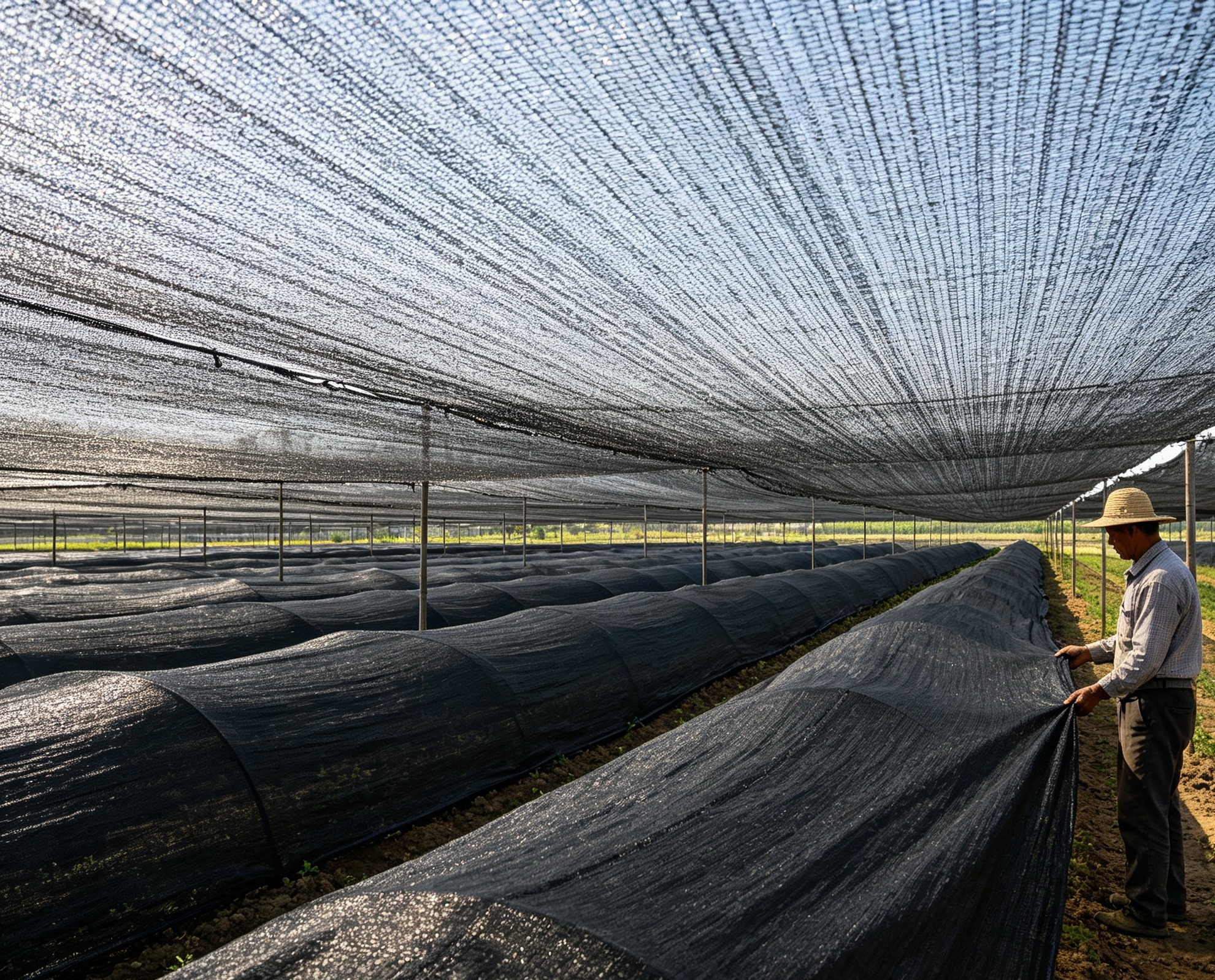
Knitted shade net is a distinct greenhouse product defined by interlocking loops rather than a rigid flat-tape grid. Its flexibility can simplify curved roofs, retractable screens, and cut-to-size panels, but buyers still need to specify stretch, cut-edge behavior, seams, open area, UV stabilization, and fixing tension.
Why knitted construction suits flexible greenhouse layouts
Interlocking loops allow a knitted net to flex around curved frames, irregular bays, side screens, and retractable systems. This can reduce cutting complexity when a greenhouse has posts, vents, or changing panel shapes.
The same flexibility means the finished panel can stretch or move if it is over-tensioned, exposed to wind, or fixed with unsuitable clips. Request the expected dimensional tolerance and installation method for the exact construction.
Check cut edges, laddering, and panel stability
Knitted net should be assessed after cutting, not only as a full roll. Ask whether the edge is heat sealed, folded, sewn, or supplied with a reinforced hem, and test a cut sample for loop opening or laddering.
For large roof panels, specify finished width and length, seam layout, overlap, and attachment points. A flexible net still needs stable dimensions so the greenhouse team can install it without excessive rework.
Match shade and open area to greenhouse ventilation
The knitting method creates an opening pattern that affects light transmission and airflow. Two products with the same nominal shade percentage may behave differently when installed on a roof, sidewall, or internal screen.
Ask for shade percentage, light transmission or open-area data, test method, color, and sample tension. Evaluate the screen with roof vents and side openings rather than treating shade percentage as a standalone cooling guarantee.
Specify UV stabilization for the actual use cycle
A knitted net used outdoors year-round needs a different weathering specification from a seasonal internal screen that is removed and stored. UV life also depends on resin, pigment, climate, contamination, tension, and repeated folding.
For a commercial order, request the exposure assumption, aging method, strength-retention evidence, warranty terms, and a retained sample. Keep this evidence separate from the construction decision so future UV-grade articles can address durability in greater detail.
Knitted shade-net specification table
| Requirement | What to specify | Why it matters |
|---|---|---|
| Construction | Knitted loop structure and yarn type | Confirms the product being quoted |
| Optical target | Shade percentage, color, and test method | Controls crop light and heat |
| Airflow | Open area or light-transmission data | Supports ventilation planning |
| Dimensional behavior | Finished size, stretch tolerance, and panel shape | Prevents installation mismatch |
| Edges and seams | Heat cut, sewn hem, reinforcement, eyelets, and seam layout | Reduces edge opening and wind damage |
| Operating cycle | Fixed, retractable, seasonal removal, or internal screen | Sets handling and durability requirements |
Install and validate before scaling up
Use the approved sample to check cutting, edge behavior, clip compatibility, tension, overlap, vent operation, and access around posts and irrigation lines. Record the panel dimensions before and after installation so the supplier and installer share the same reference.
During the first crop cycle, compare light level, temperature, humidity, plant response, and the condition of high-wear edges. This short validation can identify an installation issue before a full greenhouse project is covered.
Frequently asked questions
Is knitted shade net good for greenhouse roofs?
It can be suitable for fixed or retractable roofs when its shade target, open area, edge treatment, stretch tolerance, and fixing method match the structure and local wind conditions.
Does knitted shade net fray when cut?
Cut-edge behavior depends on the yarn and finishing method. Approve a cut sample and specify heat-cutting, sewing, folded hems, or reinforcement before production.
What information should I send for a knitted shade-net quotation?
Send greenhouse dimensions, roof or sidewall position, crop, target shade, color, fixed or retractable use, panel sizes, wind exposure, outdoor months, quantity, and delivery destination.
Send us your purchasing requirements.
Include the target specification and quantity for a more useful response.
Get a Quote