
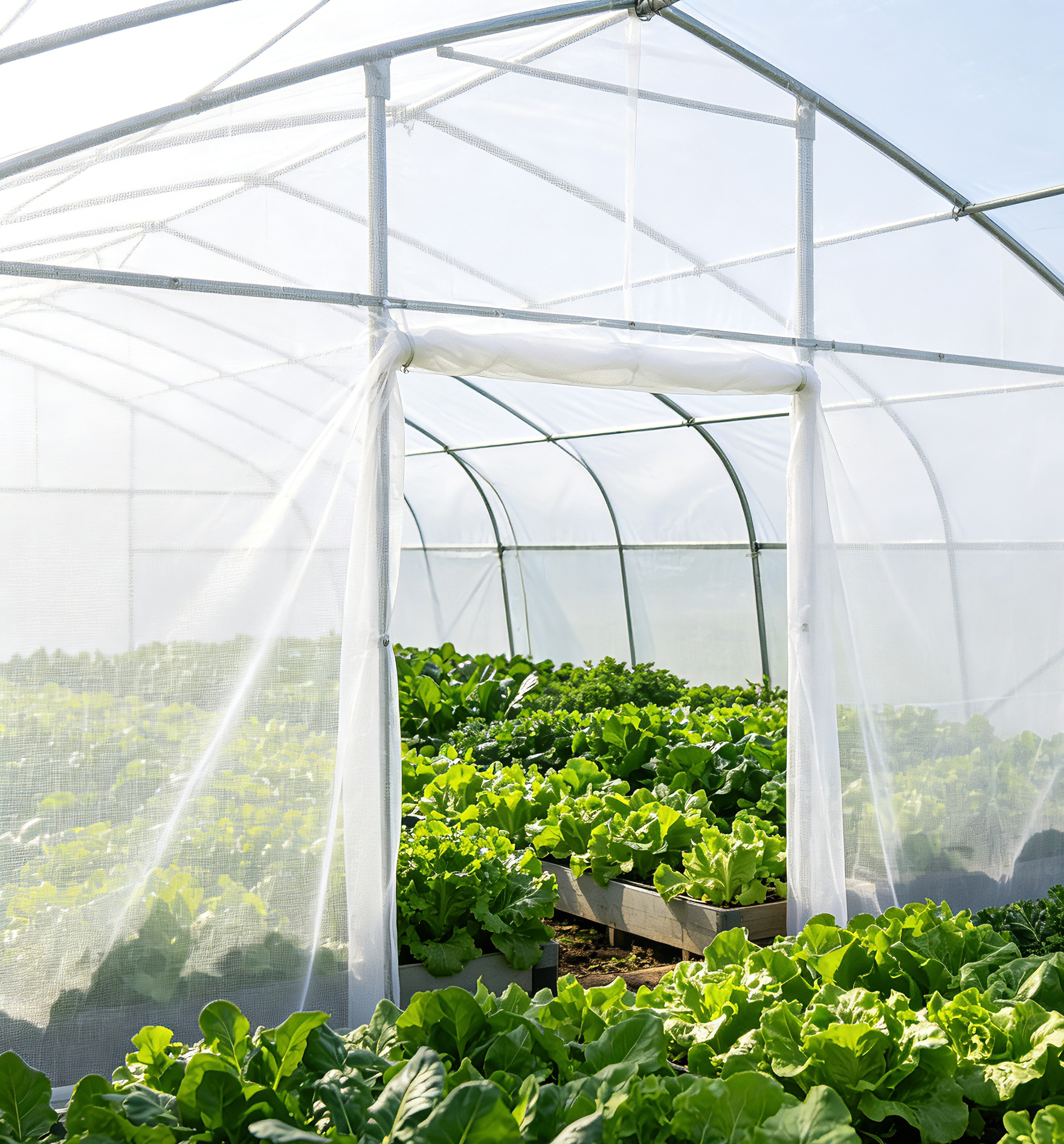
Egyptian greenhouse vegetable production must exclude pests while releasing heat from vents and limiting the effect of dust, low humidity, and strong sun. Insect net selection should begin with the target pest and measured aperture, then be checked against airflow, fan capacity, light, UV exposure, and cleaning access.
Define the pest and Egyptian production site
A greenhouse near the Nile Valley, Delta, desert-edge production area, or a coastal site may have different pest pressure, wind, dust, humidity, and ventilation requirements. Tomatoes, cucumbers, peppers, and leafy vegetables also differ in canopy density and disease risk.
State the farm location, crop, target pests, vent position, greenhouse dimensions, fan or natural-ventilation design, operating season, and whether the net is fixed or removable. This information prevents a generic mesh number from becoming the whole specification.
Use aperture, not mesh count alone
Mesh labels vary between suppliers and do not fully describe the opening. Yarn diameter, construction, and counting convention can make two products with the same nominal mesh behave differently.
Request measured aperture in microns or millimetres, yarn type and diameter, GSM, open area, light transmission, and the test method. Match the smallest pest that must be excluded while checking whether the greenhouse can still remove heat.
Balance pest exclusion with hot-climate airflow
Finer insect net can increase pressure drop and raise inside temperature when wind is low or vents are undersized. Dust can also reduce effective open area over time, so a high-exclusion product requires a realistic cleaning and inspection plan.
Review total vent area, fan capacity, net position, wind direction, screen cleanliness, and crop heat load. For critical houses, compare pressure-drop or airflow data rather than assuming a finer net is automatically the best choice.
Specify UV, seams and access for desert exposure
Strong sun can reduce polymer strength over time, while dust and repeated cleaning can wear edges, seams, clips, and access panels. The net should be supported at high-wear points and remain repairable without removing an entire greenhouse side.
Specify UV stabilization, width and length tolerance, reinforced hems, joining method, clips or profiles, door overlap, inspection panels, washing method, and the procedure for replacing a damaged section. Keep spare rolls or repair patches with the project materials.
Compare insect-net options for Egyptian greenhouses
| Selection issue | Main priority | What to confirm |
|---|---|---|
| Small target pests | Validated fine aperture | Pest size, measured opening, pressure drop, fan capacity |
| Hot summer vents | Airflow and heat release | Open area, total vent area, wind, cleaning plan |
| Dust-exposed desert edge | Cleanability and stable opening | Yarn, washing method, UV, replacement access |
| Tomato or cucumber house | Pest exclusion with canopy ventilation | Vent position, crop density, humidity, light transmission |
| Large commercial project | Repeatable panels and serviceability | Finished sizes, hems, profiles, labels, spare sections |
Egypt-specific insect-net RFQ checklist
- Farm location, crop, target pest, and production season
- Greenhouse drawing, vent dimensions, fan capacity, and airflow path
- Aperture in microns or millimetres, mesh label, yarn, and GSM
- Open area, light transmission, pressure-drop or airflow data
- UV stabilization, dust exposure, washing, and expected service life
- Width, length, reinforced hems, seams, profiles, clips, and door overlap
- Fixed, roll-up, or removable installation and spare-panel plan
- Approved sample, lot traceability, labels, packing, and delivery destination
- Field trial measurements for temperature, humidity, pest ingress, and cleaning
Frequently asked questions
What insect net is suitable for greenhouse vegetables in Egypt?
Select the aperture from the target pest, then confirm airflow, vent area, fan capacity, light transmission, dust exposure, UV stabilization, and the crop's heat and humidity requirements.
Is 50 mesh always the best choice for Egyptian greenhouses?
No. Mesh count alone does not prove aperture or airflow. Compare measured opening, yarn construction, pressure drop, pest exclusion, and the local greenhouse climate.
How should insect net be maintained in dusty Egyptian conditions?
Plan inspection and cleaning according to the net material and farm water quality, keep vents accessible, check pressure or temperature changes, and replace worn edges or blocked sections promptly.
Send us your purchasing requirements.
Include the target specification and quantity for a more useful response.
Get a Quote