
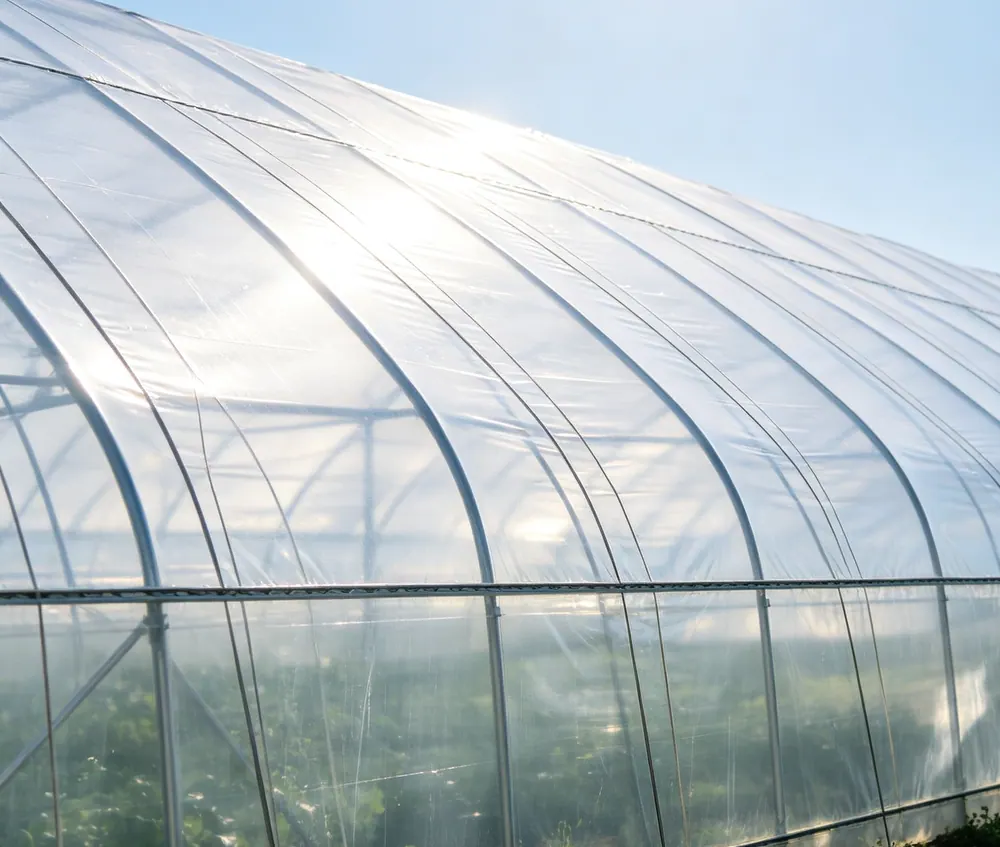
For Saudi cucumber houses, asking only for a thick UV film leaves the most important design questions unanswered. The covering changes crop light, daytime heat gain, condensation behavior and cooling demand. Dust accumulation, structure geometry, ventilation, evaporative cooling and the production season must be considered before selecting transmission, diffusion and thermal features.
Recommended specification approach
Start with the production season and greenhouse system. A naturally ventilated house, a fan-and-pad house and a cooled high-technology greenhouse do not place the same demand on the covering.
Request measured total light transmission, haze or diffusion, thickness tolerance, anti-drip performance, UV stabilization evidence and compatibility with the farm's crop-protection chemicals. Product names such as 'cooling film' are not substitutes for data on the exact construction.
Balance useful light against cooling load
Cucumbers need productive light, but excessive solar gain can raise leaf and air temperature and increase cooling demand. Diffusion can spread light through the canopy, while excessive reduction in total transmission can limit production during lower-light periods.
Model or trial the covering with the actual greenhouse orientation, screen system, ventilation and cooling capacity. A film should not be expected to correct an undersized cooling system by itself.
Saudi greenhouse film decision table
| Site or system factor | Film property to discuss | Project check |
|---|---|---|
| Hot-season production | Transmission, diffusion and heat-management option | Inside temperature and cooling-energy trial |
| Fan-and-pad greenhouse | Uniform light and compatible condensation control | Air path, pad sizing and crop rows |
| Dust exposure | Cleaning compatibility and optical retention | Water quality, cleaning method and access |
| High UV exposure | Stabilization and retained mechanical strength | Aging evidence and chemical-use assumptions |
| Cool nights or winter crop | Thermal behavior and anti-drip | Night humidity, condensation and disease plan |
Dust, cleaning and chemical exposure
Dust reduces transmission and can make two identical films perform differently after installation. Plan safe roof access, cleaning frequency and suitable water before approving a covering. Abrasive methods can damage the surface or anti-drip treatment.
Sulfur and chlorine exposure can affect stabilized polyethylene. Tell the supplier which pesticides, disinfectants and application methods are used so the offered stabilization package and warranty conditions can be reviewed.
Saudi cucumber greenhouse RFQ checklist
- City or production area, season and cucumber variety
- Greenhouse dimensions, orientation, roof shape and film width
- Natural ventilation, fan-and-pad, fogging and shade-screen details
- Target total transmission, diffusion and anti-drip performance
- Nominal thickness plus average and minimum tolerance
- UV exposure, dust, cleaning water and agricultural chemicals
- Expected service period, quantity, packing and delivery destination
Frequently asked questions
What greenhouse film is suitable for cucumbers in Saudi Arabia?
Select it from season, greenhouse design, cooling system, crop light requirement, dust, UV exposure and condensation conditions. Require measured data for the exact film.
Is more diffusion always better in a hot greenhouse?
No. Diffusion must be considered with total transmission, canopy, season and cooling design. Trial shortlisted films under representative conditions.
How thick should Saudi greenhouse film be?
Thickness depends on span, wind, installation, service period and handling. Specify nominal, average and minimum thickness tolerances rather than relying on one nominal number.
Send us your purchasing requirements.
Include the target specification and quantity for a more useful response.
Get a Quote