
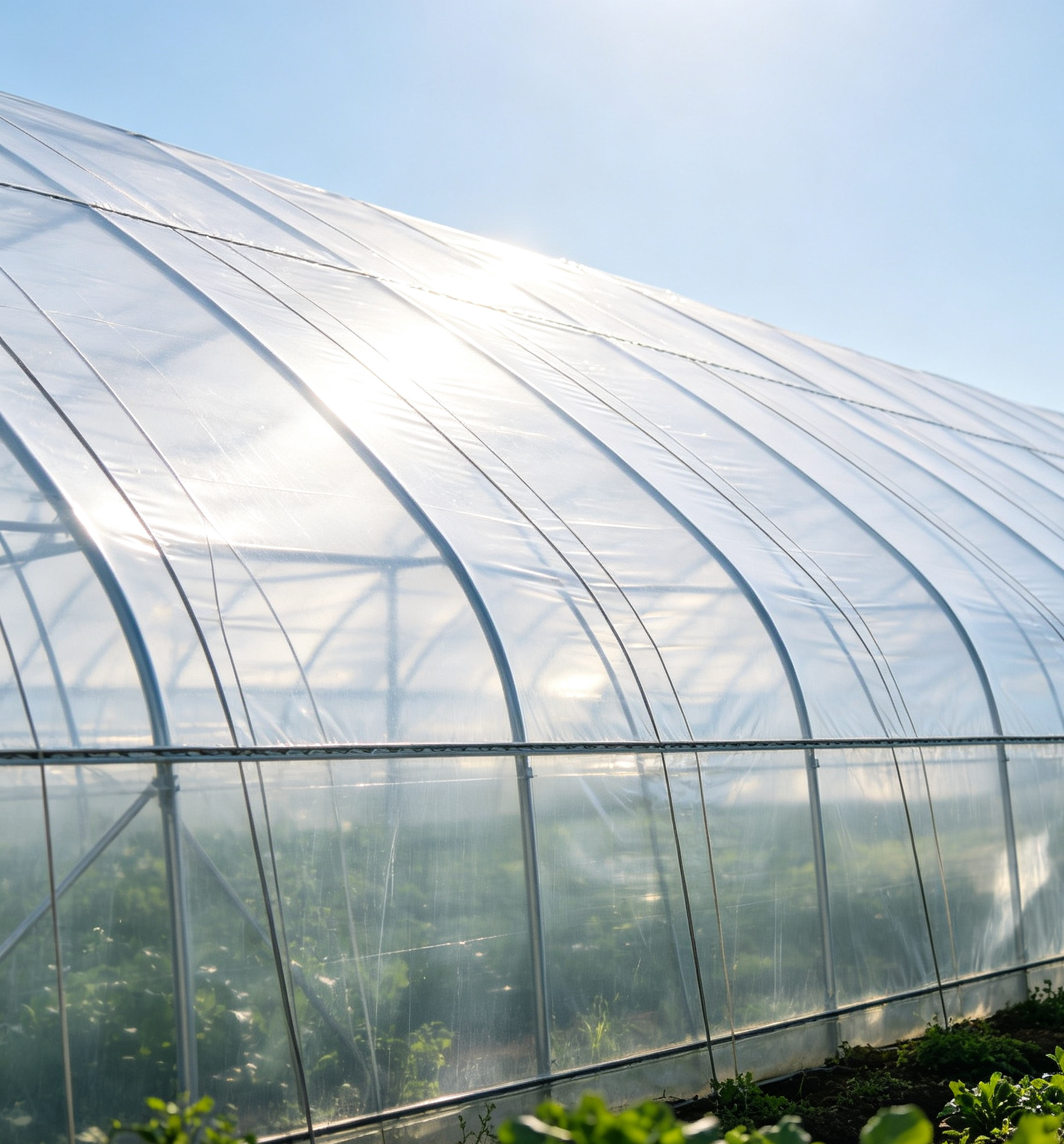
Kenyan flower farms need greenhouse film that supports light management, condensation control, mechanical reliability, and consistent crop conditions under highland sun, cool nights, seasonal rain, and wind. Film should be specified for the flower variety and greenhouse block, not purchased only by micron or a generic service-life label.
Connect film selection to Kenya's flower-growing zones
Production around Naivasha, Nairobi, Nakuru, Mount Kenya, and other highland areas can differ in elevation, solar load, night temperature, wind, rainfall, and greenhouse design. These conditions influence film aging, condensation, heat balance, and the useful light reaching flowers.
Give the supplier the farm location and elevation, flower variety, greenhouse orientation, structure dimensions, ventilation, heating or cooling practice, installation date, and expected replacement cycle. A project-specific specification is more useful than a country-wide generic grade.
Use diffused light to support flower-house uniformity
Clear transmission is not the only optical target. Diffusion can distribute light more evenly through the canopy and reduce hard shadows, while excessive haze or a low-transmission film can reduce productive light during cloudy periods.
Request initial and aged light transmission, haze or diffusion data, color, and the test method. Compare the exact film sample under the greenhouse orientation and crop density where possible, especially when flower stem quality and uniformity are commercial acceptance criteria.
Specify UV and anti-drip for the actual block
High solar exposure can accelerate polymer aging, but UV grade alone does not determine film life. Thickness, resin formulation, installation tension, chemical contact, dust, wind movement, and hot contact points also affect performance.
Condensation is another separate requirement. Ask how anti-drip performance is tested, how long it is expected to last, and whether pesticide, sulfur, chlorine, or cleaning practices are compatible with the film. Record the inside and outside orientation before installation.
Account for wind, rain and replacement logistics
Flower-house film must resist installation damage and remain stable at clips, gutters, ridge lines, and contact points. Wind can turn a small loose edge into repeated movement and premature tearing, while rain and dust can reduce optical performance.
Specify width, length, thickness tolerance, roll weight, core, winding direction, seam or repair method, storage limit, and the procedure for inspection after installation. For large Kenyan projects, include roll labels and a block-by-block replacement plan.
Compare film priorities for Kenyan flower production
| Project concern | Film priority | Evidence to request |
|---|---|---|
| Highland strong sun | UV and optical stability | UV package, aging evidence, transmission retention |
| Flower canopy uniformity | Useful diffusion without excessive light loss | Initial and aged transmission, haze, test method |
| Cool nights and condensation | Anti-drip and climate compatibility | Anti-drip duration, installation orientation, chemical limits |
| Wind-exposed structure | Tear, tensile, and edge reliability | MD/TD strength, thickness tolerance, fixing guidance |
| Large export farm | Repeatable rolls and replacement control | Lot traceability, labels, packing, retained sample |
Kenya flower-farm RFQ checklist
- Farm location, elevation, flower variety, and greenhouse block
- Greenhouse dimensions, orientation, vents, gutters, and fixing profile
- Target light transmission, diffusion, color, and crop-quality objective
- Film polymer, layer structure, thickness, width, length, and tolerance
- UV stabilization, anti-drip, anti-fog if required, and chemical compatibility
- Tensile, tear, impact, winding, repair, and installation data
- Wind, rain, dust, night temperature, and replacement schedule
- Roll core, weight, labels, lot traceability, retained sample, and packing
- Trial block, pre-shipment inspection, and destination delivery terms
Frequently asked questions
What greenhouse film is suitable for flower farms in Kenya?
Choose from the flower variety, elevation, solar exposure, required transmission and diffusion, condensation conditions, structure, wind, and expected service life. Request data for the exact film construction.
Is a higher UV grade always better for Kenyan greenhouses?
A suitable UV package is important under strong sun, but performance also depends on resin, thickness, installation, chemical exposure, and verified aging evidence. A higher label alone is not enough.
Should Kenyan flower farms use diffused greenhouse film?
Diffused film may improve light distribution and reduce hard shadows, but the best level depends on crop, canopy, climate, and total transmission. Validate the exact sample in a representative block.
Send us your purchasing requirements.
Include the target specification and quantity for a more useful response.
Get a Quote